
Why tracking your job search is a non-negotiable habit
When people decide to kickstart a career pivot or look for a new role, they usually want to jump straight into the flashier elements. They want to rewrite their CV, spruce up their LinkedIn profile or start building their personal brand.
Those things are all vital. We will get to them later in this series!
But whenever I sit down for a career consultation with somebody, one of the very first things I ask is: "What have you done so far on your job hunt?"
More often than not, the answers are scattered. People remember a few company names, a couple of interviews from last month and a vague number of applications. Because they haven't properly tracked their actions, they cannot give a clear picture.
This is where the frustration sets in. When a job search stalls, you need to be able to look at the data to pinpoint exactly where things are going wrong. Is it a CV issue because you aren't getting callbacks? Is it an interview technique issue because you are stalling at the first stage? Without a tracked history, we are just guessing. Organisation isn't a boring administrative chore: it is the diagnostic foundation of your entire search strategy.
And right now, most people are starting on the back foot.
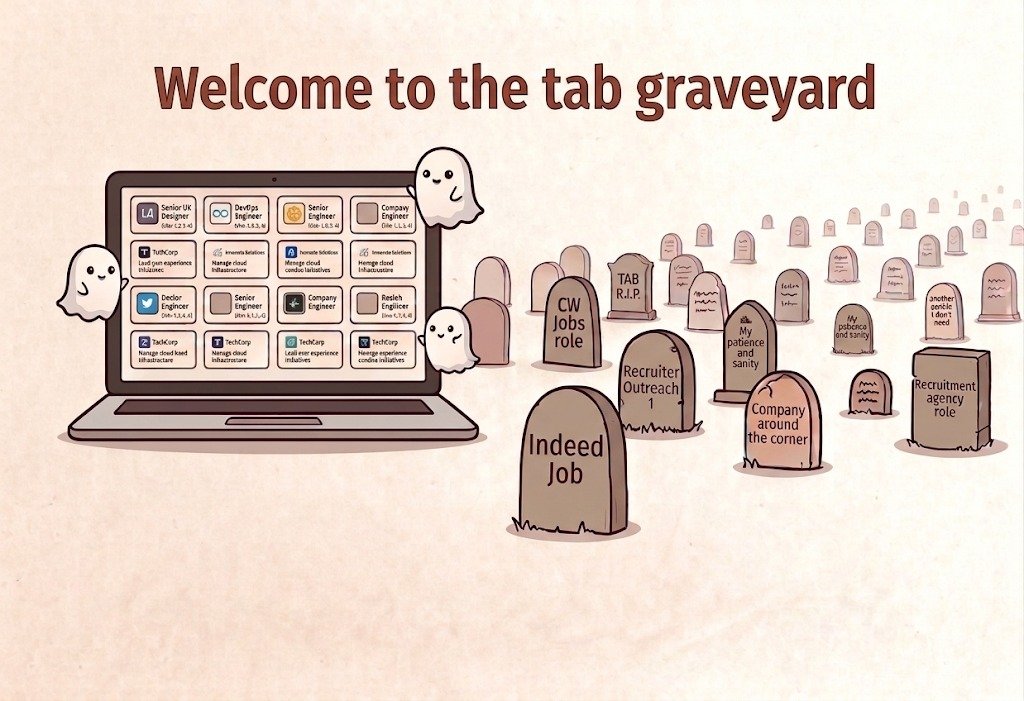
The tab graveyard
We have all been there. You open your laptop on a Tuesday morning and suddenly you have more tabs open than your local pub the day before payday. You have multiple windows full of job adverts, company career pages, random LinkedIn profiles and whatever other miscellaneous clutter you have picked up along the way (in my case, the miscellaneous stuff is almost always another purchase I don't need).
It feels right in the moment. You tell yourself, "I will just leave this open so I do not lose it or forget about it."
In reality? It is a recipe for messy mental clutter and intense search burnout. Living in a tab graveyard might seem harmless, but it actively damages your momentum before you even submit an application.
The recruiter callback panic
Let's paint a very common, very stressful picture. You are setting up job alerts, networking and applying for any job where you feel you meet at least half of the criteria or where you have a compelling reason to resonate with the company.
Your phone rings. It is an unknown number. You answer, and it is a recruiter who wants to talk to you right now about "opportunity X".
Which one was that again?
Let's be honest about the reality of the job market right now. It is tough out there. The volume of applications per role has skyrocketed, and you are competing against a tidal wave of generic, AI-generated CVs. There is a massive pressure and urgency to produce quality job applications to cut through that noise, which is incredibly time-consuming and frustrating given the sheer amount of tumbleweed companies are giving out at the moment.
Because sorting through all of this takes time, the traditional recruitment timeline has completely stretched out. An application you submitted six weeks ago, which you had realistically completely forgotten about, might suddenly spark a live callback. (And if you are targeting public sector roles or large corporate organisations, they have always notoriously taken months to respond anyway).
This delayed timeline makes a structured system essential. Without one, the instant the phone rings, internal meltdown sets in.
You begin frantically fumbling around on your laptop, trying to click through browser tabs that are now so tiny you cannot even read the headlines. You are stressed, your heart is racing and you only half hear what the recruiter is trying to tell you because you are trying to maintain an air of professionality whilst having an intense internal panic. You find the job spec, now which version of your CV did you send?
Fumbling blindly through files whilst trying to sound confident is a fast way to damage your credibility before the interview process has even begun. But worse than that? It inflicts a mountain of completely unnecessary stress on you. You are forced to start a high-stakes conversation completely flustered, anxious and on the back foot. Rinse and repeat. It is absolutely exhausting.
Moving from chaos to control
The antidote to this nightmare is simple: you need one single place to save your information. When you build a solid tracking habit, you reclaim a massive chunk of your mental bandwidth.
Instead of holding fifty job descriptions, deadline dates and recruiter names in your head, you offload them onto a system. When that unknown number flashes on your phone, you do not panic. You open your tracker, type in the company name and instantly see:
The original job description (even if the employer has taken the live listing down)
The exact version of the CV and cover letter you submitted
The names of the people you spoke to and your follow-up notes
You step into the conversation calm, prepared and completely in control.
Build a system that works for you
Whether you use Huntr, Excel, Notion, Trello or a physical notebook, you do not need to make it complicated. To make it a sustainable habit, you only need to track five core pieces of data for every single role:
The Basics: Job title, company name, location and salary.
The Assets: The exact version of the CV and cover letter you submitted (label them clearly in your folders so you can match them up instantly) and the job description for the role you applied for.
The Timeline: The date you applied and the closing deadline.
The Network: The name of the recruiter, hiring manager, or agency contact, ideally along with their email address and LinkedIn profile.
The Live Status: A clear category showing where the role stands (e.g., To Apply, Applied, First Interview, Rejected, Offer).
The goal is to keep it simple enough that it takes you less than sixty seconds to log a job. If your system is too high-maintenance, you will abandon it within a week.
My recommendation: Huntr
For the past four years, the tool I have personally worked with and recommended to job hunters to automate this process is Huntr. I do not recommend software willy-nilly, but Huntr genuinely fixes this exact callback meltdown.
It uses a brilliant browser extension that completely removes the friction of tracking. Tracking shouldn't start with messy forms or endless copy-pasting: it should be automatic. When you land on a vacancy on LinkedIn, Indeed or a corporate board, the extension reads the background metadata instantly.
From there, it takes exactly two specific clicks to secure your peace of mind:
Click the active Huntr extension icon in your browser toolbar to open the parsed job card preview.
Click the "Save to Huntr Board" button.
That is it. The description, text specs and company fields drop instantly into your tracking pipeline, and you can close that browser tab for good.
The best part? Everything I have covered so far is focused entirely on tracking your job hunt, and all of these core tracking features, like your pipeline board, document vault and contact logging CRM, are 100% free to use. (They do have optional paid premium upgrades for things like AI cover letter builders or application autofill tools, but you do not need them just to stay organised).
If you want to try it out, you can use my referral link here: https://huntr.co/?via=jennifer.
But here is my honest caveat: you need to do whatever works for you. Whether you use a dedicated platform like Huntr, a Trello board or a beautifully organised physical notebook, the tool matters less than the habit itself.
Stop living in the tab graveyard and end the phone call panic. Find a system that clears your mental clutter, protects your headspace and allows you to show up to your next recruiter call with total confidence.
